
Choose for the finished landscape—not the nursery pot
Before buying, record the bed width, hours of direct sun, drainage after heavy rain and the maximum height you can live with. Then check the exact cultivar tag. A plant that naturally fits its location will usually look better with less pruning, watering and replacement.
A nursery can be a dangerous place for a garden plan. Everything is compact, freshly watered and arranged to look good on the day you visit. The harder question is what that three-gallon shrub will be doing beside your front walk five years from now.
For landscapes across Surrey, Langley and the surrounding Lower Mainland, a useful plant needs to fit the available space, handle the property’s sun and drainage, and still earn its place after the first flush of bloom is gone.
These eight plants solve different landscape problems. They are not interchangeable, and not every one belongs on every property. Use this as a practical shortlist—not a shopping list to buy without measuring first.
1. Panicle hydrangea

Panicle hydrangeas produce cone-shaped summer flowers that often age from white into pink and tan. They tolerate sun and winter cold better than familiar bigleaf hydrangeas, but the cultivar name matters: the species can become a substantial shrub or small tree, while compact cultivars remain much lower.
- Best fit
Flowering specimen, informal hedge or back-of-border shrub. - Site
Morning sun, afternoon shade and consistent moisture with good drainage. - Maintenance
Prune selectively in late winter or early spring; flowers form on new growth.
Do not buy “a hydrangea” without checking its finished height and width. That distinction determines whether it belongs beneath a window or at the back of a broad bed. A layer of composted bark mulch can help moderate moisture, but keep mulch away from the stems.
2. Inkberry holly

Inkberry is a North American native evergreen with small, spineless leaves. It can provide some of the quiet structure people expect from boxwood, especially in a looser hedge or foundation planting.
- Best fit
Informal evergreen massing, rain-garden edges and low screening. - Site
Full sun to partial shade in acidic soil that holds some moisture. - Maintenance
Usually light; older stems may open near the base and the species can sucker.
If black fruit is part of the plan, remember that hollies have separate male and female plants. A compatible male must be nearby for female plants to set berries.
3. Ninebark

Ninebark has arching branches, clusters of white-to-pink flowers and peeling bark that becomes visible in winter. Green, gold, copper and dark-purple cultivars are common.
- Best fit
Mixed shrub borders, flowering screens, slopes and rain-garden margins. - Site
Full sun to part shade across a wide range of soils. - Maintenance
Prune after bloom; renew congested plants by removing selected old stems at ground level.
The species is large. Even smaller cultivars need enough width to hold their natural arching shape. Repeated shearing in a narrow strip removes the character you bought it for.
4. Serviceberry
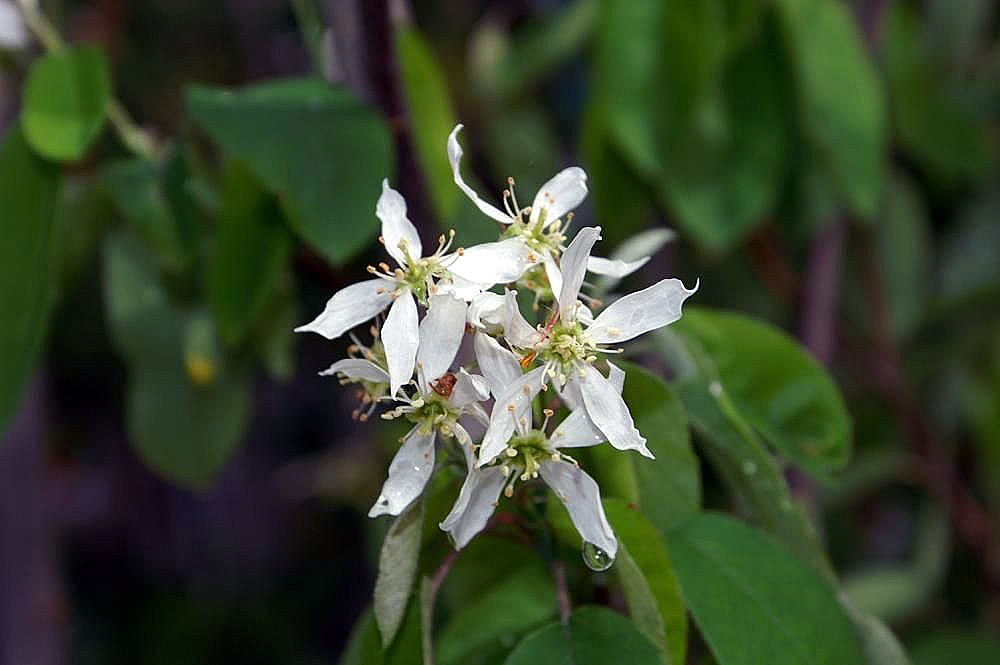
Serviceberry works where a property needs a small ornamental tree with more than one good season. White spring flowers arrive before the leaves fully open, dark fruit follows, and fall colour can move into orange and red.
- Best fit
Woodland edges, mixed borders, naturalized areas or a small multi-stem specimen. - Site
Moist, well-drained soil; sun to part shade with consistent moisture. - Maintenance
Modest once established; choose shrub form or tree form before buying.
The fruit is edible, but birds often get there first. That can be a benefit in a habitat garden or a nuisance over a patio, walkway or parked car.
5. Red-twig dogwood

Red-twig dogwood earns its space after many plants go quiet. Once the leaves fall, young stems provide strong red winter colour against stone, evergreen foliage and grey weather.
- Best fit
Damp low spots, rain gardens, broad shrub masses and pond edges. - Site
Full sun to partial shade in consistently moist soil. - Maintenance
Remove selected older stems near ground level to encourage colourful new growth.
This is a vigorous, spreading shrub. That makes it useful for erosion control and larger wet areas, but less convincing in a tiny foundation bed.
6. Switchgrass

Switchgrass is a North American native warm-season grass that adds height, movement and winter structure. Cultivars vary from compact clumps to plants whose flower stems rise well above head height.
- Best fit
Repeated groups in sunny borders, soft screening and rain gardens. - Site
Full sun; adaptable to clay or sandy soil and periodic wetness or drought. - Maintenance
Leave standing through winter, then cut down before spring growth begins.
In enough sun, good cultivars hold an upright form. In too much shade—or when overfed—they can loosen and flop onto neighbouring plants and paths.
7. Catmint

Catmint softens sunny walkways and the front of perennial beds with grey-green foliage and blue-purple flowers. Common Nepeta × faassenii types are sterile hybrids rather than plants native to coastal British Columbia, but they are dependable where drainage is good.
- Best fit
Sunny borders, path edges and combinations with upright shrubs or grasses. - Site
Full sun and well-drained soil; wet winter soil is harder on it than summer drought. - Maintenance
Shear after the first heavy bloom for a tidier mound and another flush.
Check the cultivar’s finished width. Some form modest mounds; others spread several feet and can lean into a path.
8. Black-eyed Susan

Black-eyed Susan provides strong midsummer-to-fall yellow. It is native to eastern North America rather than specifically to coastal British Columbia, and it works well in pollinator beds and looser perennial combinations.
- Best fit
Pollinator gardens, sunny banks, perennial beds and naturalized plantings. - Site
Full sun to partial shade in moist but well-drained soil. - Maintenance
Deadhead for longer bloom or leave seed heads for birds and reseeding.
Rudbeckia hirta is often biennial or short-lived. It may remain in a garden by reseeding rather than because each original plant lives for many years.
A better way to shop the nursery
Buy for a role. Are you screening a view, holding a wet slope, adding winter structure, softening a walkway or filling a sunny perennial bed? A plant that solves a site problem is more likely to look intentional years later.
Give shrubs and grasses room to reach their listed width. Gaps can look open in year one, but they are healthier and less expensive than a crowded planting that must be moved or constantly cut back in year three.
Atkinson’s planting team can help match plants to the light, drainage, scale and maintenance level of your property.
References
Plant characteristics and maintenance guidance were checked against the NC State Extension Plant Toolbox entries for panicle hydrangea, inkberry, ninebark, serviceberry, red-twig dogwood, switchgrass, catmint and black-eyed Susan.